Four Weddings
There is no standard format for an Indian wedding. There are four weddings, each with its own order of events. Rosemary & Harman, in August 2026, spread their celebration over three days, from Haldi at Gleis 21 to a symbolic ceremony in Schlosspark Laxenburg. Minu & Nobin, the same summer, celebrate everything in a single day, from the church ceremony at Pfarrkirche St. Elisabeth to the reception at ThirtyFive above the rooftops of Vienna. Tony & Savitha, in August 2025, marry at the Jesuit Church, combining South Indian and Christian rites with the thali necklace and the Manthrakodi cloth. Engla & Leyon at Weinschloss Thaller begin with the civil ceremony, followed by a short church ceremony with the thali. What remains are four different days — and the realisation that neither region, faith nor guest count can be reduced to a formula.


The Haldi Ceremony
How Many Days Does It Take?
How long it takes depends entirely on which ceremonies come with it. For Rosemary & Harman, it is three days with a total of 19 hours of coverage. On the first day at Gleis 21 in Vienna, Haldi, Mehndi, Sangeet and Madhuramveppu follow one another, with around 50 guests. Haldi is the ceremony in which turmeric paste is applied to skin and clothing. Mehndi is the painting of hands with henna. Sangeet is the evening of dancing. Madhuramveppu — also written Madhuram Veppu — is the ritual feeding of the bride by relatives. The second day brings the registry office in Mödling, with about 30 guests, and a visit to the Gurdwara, the Sikh house of worship — booked by their witnesses as a gift. On the third day comes the symbolic ceremony outdoors in Schlosspark Laxenburg, with around 100 guests. The other three weddings condense everything into a single day. Minu & Nobin celebrate for 12 hours, from the ceremony at Pfarrkirche St. Elisabeth to the reception at ThirtyFive. Tony & Savitha also need 12 hours, from the Jesuit Church to the Hilton Am Stadtpark, with 250 guests. Engla & Leyon stay at Weinschloss Thaller for both the civil ceremony and a short church ceremony, with 150 guests. Both approaches work. The difference is not how much happens each day, but whether the pre-wedding rituals get a day of their own.

The Civil Ceremony
Where Does the Civil Ceremony Fit In?
Legally, the civil ceremony is the actual marriage — and yet at these weddings it is the shortest and most matter-of-fact part. Where it sits determines how everything else falls into place around it.
For Rosemary & Harman it takes up the second day. Between the pre-wedding rituals at Gleis 21 and the symbolic ceremony in Schlosspark Laxenburg, the two stand with their witnesses in front of the registrar at Mödling registry office, with around 30 guests. Coming after a day of Haldi, Mehndi, Sangeet and Madhuramveppu with 50 guests, and ahead of a day with 100, this small gathering is the calm centre of the three days.
For Engla & Leyon at Weinschloss Thaller, the civil ceremony falls on the same day as the short church ceremony with the thali necklace. Here it is not a day of its own but the prelude to the ceremony under the pavilion, with 150 guests. The two weddings have only one thing in common: the civil ceremony needs its own slot in the schedule, even if it takes very little time itself.


The Gurdwara Visit
Can a Ceremony Be Added Later?
Yes — and Rosemary & Harman's second day proves it. The visit to the Gurdwara was not part of the original plan. It came later, as a gift from their witnesses, and was booked as an add-on.
It ended up on the same day as the registry office in Mödling, so the second day held two very different moments: the brief civil ceremony in front of the registrar, and the visit to the Gurdwara, where Rosemary in a red lehenga and Harman in a white sherwani bow while the guests sit on the red carpet. A schedule spread over several days, in other words, is never quite fixed — as long as a day has some breathing room, there is space for another ceremony.


Anyone planning an Indian wedding is planning their own — the families' region and faith matter more than the country.
— Walking Weddings

Thali and Manthrakodi
Which Rituals Come With It?
The rituals depend on the families' region and faith. Tony & Savitha combine South Indian and Christian elements at the Jesuit Church and Hilton Am Stadtpark. During the ceremony, the groom ties the thali necklace around the bride's neck — a necklace that marks her as married — and then hands her the Manthrakodi, a red cloth that is draped around her. Both are South Indian Christian rites that do not appear in any of the other three weddings. Engla & Leyon also have a thali ceremony, but without the Manthrakodi and in a different setting: under a pavilion at Weinschloss Thaller, as a short church ceremony after the civil one. Rosemary & Harman have neither Thali nor Manthrakodi, but instead the pre-wedding rituals Haldi, Mehndi, Sangeet and Madhuramveppu, which none of the other three include. Minu & Nobin focus on the church ceremony at Pfarrkirche St. Elisabeth and the subsequent reception. Each wedding has its own rites, and none of the four overlaps completely with another.


The Wedding Reception
How Big Is the Party, and What Does Each Venue Bring to It?
Two weddings of 250 guests, one of 150, one of 100 — and none of these numbers tells you how a celebration feels. That comes down to the venue.
Minu & Nobin celebrate with around 250 guests at ThirtyFive above the rooftops of Vienna, taking over an entire floor of the tower, at long tables with views across the city. Tony & Savitha also have 250 guests, but at Hilton Am Stadtpark, at round tables in a large ballroom. Same number, two venues, two completely different evenings.
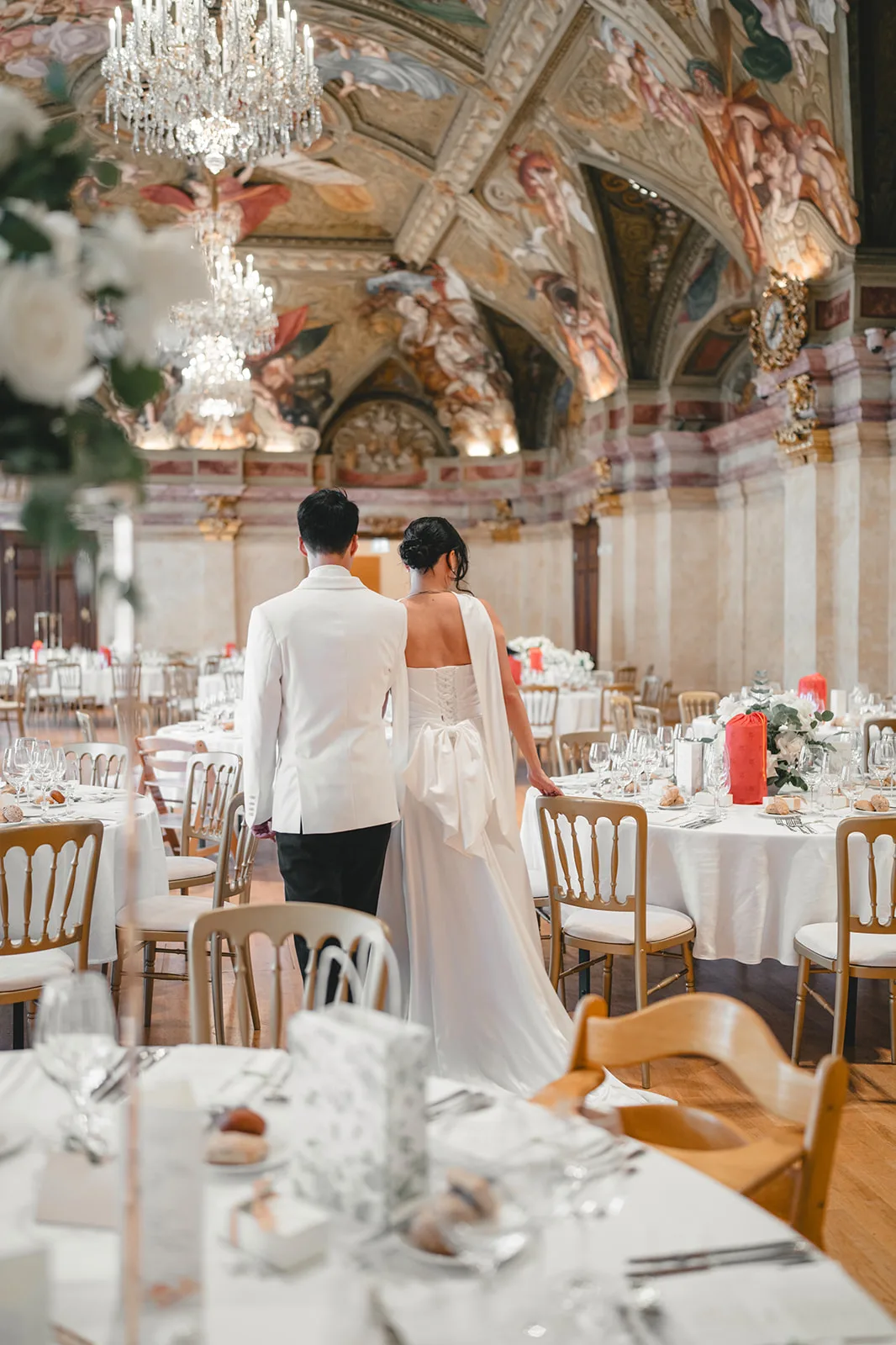
Engla & Leyon celebrate with 150 guests at Weinschloss Thaller, where the courtyard under string lights becomes the dance floor and the couple look down from the balcony onto the tables below. Rosemary & Harman invite around 100 guests to the symbolic ceremony at Schlosspark Laxenburg and celebrate afterwards in the Baroque hall of Conference Center Laxenburg, under crystal chandeliers. Over their three days, the numbers keep changing: around 50 guests at Gleis 21, 30 at Mödling registry office, 100 in Laxenburg. Every one of these venues gets loud, colourful and full of family — the venue only decides whether the party goes up, out or into the courtyard.

The Light
What Is the Light Like in These Venues?
For photography and film, light is what sets one venue apart from another most clearly. Each of these weddings had its own lighting conditions.
ThirtyFive is flooded with light because Minu & Nobin take over an entire floor of the tower; by evening, the city fills the windows. Conference Center Laxenburg is very bright during the day and, for Rosemary & Harman's evening, relies on its own ambient lighting. Hilton Am Stadtpark was well lit throughout Tony & Savitha's wedding.
Weinschloss Thaller had plenty of daylight for Engla & Leyon; in the evening the courtyard gets mixed lighting, which we balance with spotlights. And at Mödling registry office the daylight is good once the ceiling lights are switched off — otherwise two colour temperatures mix on faces in the ceremony room.
Good to Know
Is there a standard format for an Indian wedding?
No, and that is the most important answer in this piece. Four weddings, four different formats. Rosemary & Harman had pre-wedding rituals on a separate day and a Gurdwara visit, Minu & Nobin a church ceremony and a reception in one day, Tony & Savitha a South Indian Christian rite with Thali and Manthrakodi, Engla & Leyon a short church ceremony alongside the civil one. Anyone planning an Indian wedding is planning their own — the families' region and faith matter more than the country.
How many days does an Indian wedding in Vienna take?
It depends on how many ceremonies are included. For Rosemary & Harman it was three days with a total of 19 hours of coverage. The other three weddings celebrated everything in a single day, in twelve hours. Both approaches work. The difference is not how much happens each day, but whether the pre-wedding rituals get a day of their own.
Where does the Austrian civil ceremony fit in?
The civil ceremony is legally the actual marriage and often sits between the ceremonies. For Rosemary & Harman it was on the second day at Mödling registry office, between the pre-wedding rituals and the symbolic ceremony. For Engla & Leyon it took place on the same day as the church ceremony. It is usually the shortest and most matter-of-fact part of the day, yet it still needs its own slot in the schedule.
What happens if it rains?
At Weinschloss Thaller, the celebration is under cover. For the outdoor symbolic ceremony at Schlosspark Laxenburg, Conference Center Laxenburg offers Marschallzimmer 1 as a wet-weather backup for up to three hours. The remaining venues are indoors anyway. A multi-day schedule is therefore less weather-dependent than a garden wedding — if an outdoor part has to move, it shifts within the day and not across the entire schedule.
How large can the celebration at Conference Center Laxenburg be?
The Ovale Saal holds 150 people for a gala dinner and 200 for a reception, Marschallzimmer 1 holds 110 and 140 respectively, Marschallzimmer 2 holds 80 and 120 respectively, the Theatersaal holds 230 and 350 respectively. (Source: Conference Center Laxenburg, room overview, accessed September 2026.)
What does a venue like this cost?
Conference Center Laxenburg publishes its rates — a rarity among venues of this size. For 2027 the wedding brochure lists €6,610 per day from April to October and €6,000 in the off-season from November to March for the Ovale Saal, Marschallzimmer 2 and terrace. Ceremony packages range from €950 for the Kaminzimmer to €3,000 for the Theatersaal. (Source: Conference Center Laxenburg wedding brochure, accessed September 2026.) The other venues in this piece do not publish prices; pricing is on request.
lovingly captured by Walking Weddings